Blog
Custom Patches for Bands and Creators: The Merch Guide That Actually Helps

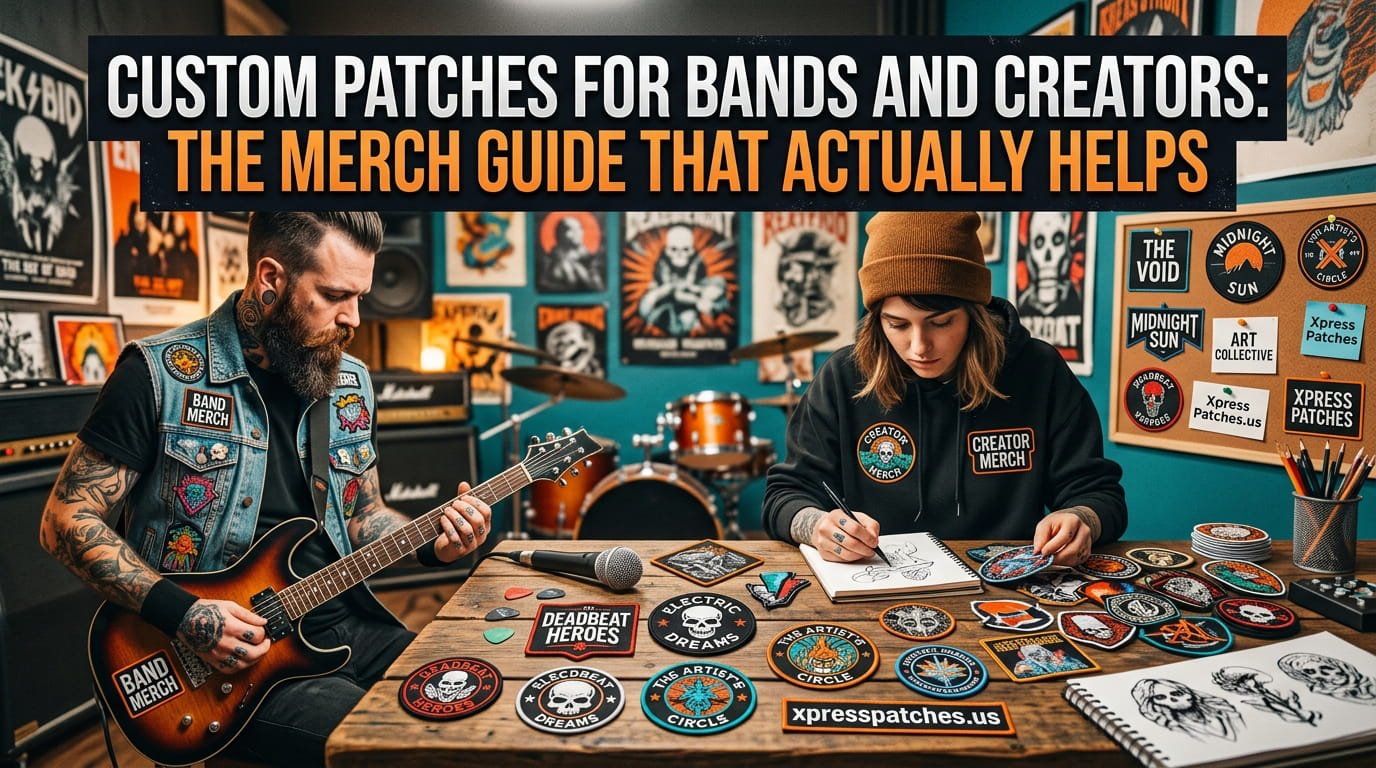
Custom patches for bands and creators sit in a strange category of merch — too small to be the main attraction, too good to leave off the table. Fans buy them without overthinking it. They’re cheap enough to grab on impulse, specific enough to feel like a real piece of the thing they care about, and durable enough to still be on a jacket five years later when everything else from that era is long gone.
This guide covers the practical side: what type of patch actually works for music and creator merch, how to price it, how much to order, and what to watch for when you’re looking at designs that might not translate well into thread.
Why Custom Patches Work So Well for Band and Creator Merch
Patches solve a problem that most merch doesn’t. T-shirts require sizing. Hoodies are expensive to produce and ship heavy. Stickers are cheap but disposable. A patch is none of those things. It ships flat in an envelope, costs a fraction of a shirt to produce, and ends up on someone’s denim jacket where it stays visible for years.
For touring bands, that’s meaningful. A $10 patch sold at a show is nearly pure margin after production cost. For online creators, it’s a physical product that doesn’t require warehousing or size variants. You pick a design, order a run, and sell them in a shop or include them in supporter tiers.
The other thing patches do that most merch doesn’t: they stack. A fan who already has your shirt will still buy the patch. They’re additive rather than redundant, which matters a lot when your audience overlaps heavily across merch drops.
Which Patch Type Is Right for Your Design?
This is the decision most first-time buyers skip over, then regret. The patch type isn’t just aesthetic — it determines what your design can actually look like once it’s made.
Embroidered Patches for Bands and Creators
Embroidered patches are what most people picture when they think of a band patch. Raised thread, textured surface, classic look. They’re the right choice for bold logos with clean lines and limited colors — the kind of design that looks sharp on denim and holds up after hundreds of washes. If your logo is a clear mark with 4 to 6 solid colors, embroidered is probably where you land.
Where embroidered patches run into trouble: very small text, thin lines, and gradients. A logo that looks clean at full size can blur at 3 inches if the letterforms are narrow or the color transitions are soft. Worth checking before you commit to a type. Our free mock-up shows you exactly how a design renders before any production happens, so you find out before rather than after.
Woven Patches for Detailed Artwork
Woven patches use finer thread and a tighter weave, which means they hold detail that embroidery can’t. If your band logo has intricate line work, small type, or a design that relies on precise edges, woven is the better call. The surface sits flatter than embroidered, which some creators prefer for a more refined look.
Printed Patches for Full-Color or Photographic Art
Printed patches use dye-sublimation rather than thread. That means they can reproduce photography, gradients, illustrations with hundreds of colors, and complex digital artwork without any of the limitations of stitching. For creators whose brand identity is built on detailed visuals — an illustrated character, a highly rendered logo, a specific album artwork — printed patches are often the only type that actually reproduces the design faithfully.
PVC Patches for a Different Aesthetic
PVC patches are molded rubber rather than fabric. They’re waterproof, don’t fray, and have a tactile quality that feels different from any other patch type. Some bands use them specifically because they look unlike anything else on a jacket or bag. Not right for every brand, but worth knowing they exist if your aesthetic leans tactical, streetwear, or outdoor.
Sizing for Merch Tables and Online Shops
For band and creator patches sold at retail, 3 to 4 inches is the sweet spot. Big enough to be legible and visually impactful, small enough to fit on the chest of a jacket, the front of a bag, or the side panel of a hat without overwhelming it. If your design is landscape-oriented, 3.5 inches wide often works well. Portrait or roughly square designs can go slightly smaller at 3 inches and still read clearly.
A mistake that’s easy to make: ordering patches too small because they look fine on the screen at 100%. Always print a paper template at the actual intended size and hold it against a jacket before you finalize the dimensions. What reads clearly at 6 inches on a monitor can disappear at 2.5 inches on fabric.
How Many to Order for a First Run
For a first run, somewhere between 25 and 50 patches is a sensible starting point. That quantity lets you test the design, the price point, and the sales channel without sitting on inventory you can’t move. Because there’s no minimum order at Xpress Patches, you’re not forced into a 100-piece minimum to make the math work.
If you’ve got a show coming up or you’re announcing a merch drop with an existing audience, you’ll have a better sense of demand and can order accordingly. Reorders on successful designs are straightforward once the design is on file. The turnaround on a reorder is faster than the first run because the digitizing is already done.
How to Price Custom Patches at a Merch Table
Most bands sell patches in the $8 to $15 range. Where you land in that range depends on size, patch type, and how the rest of your merch table is priced. A 3-inch embroidered patch that costs $2 to produce can comfortably sell for $10 at a show — fans know merch supports the artist, and patches feel like a fair exchange for that price.
A few pricing approaches that tend to work:
- Single patch at $10: simple, impulse-friendly, moves at the table without requiring a conversation
- Two patches for $15 or $18: increases average transaction, good if you have multiple designs and want fans to take more than one
- Patch plus another small item (sticker, pin): bundles often move faster than individual items priced separately
Online, $12 to $15 is a common price point that covers shipping on a flat envelope without the total feeling unreasonable. Patches ship in a standard envelope with a piece of cardboard backing, which keeps postage low and keeps the experience feeling like a personal letter rather than a package.
What Patches Work Best as Creator Merch (Not Just Bands)
YouTube channels, podcast brands, gaming communities, Twitch streamers, and newsletter writers have all found patches useful for different reasons. A few that work particularly well:
- Channel logo patches: the simplest format, but effective if the logo is strong enough to stand alone as a physical object
- Catchphrase or inside-joke patches: text-based patches that reference something specific to the community tend to convert well because they signal belonging in a way a generic logo doesn’t
- Limited run patches: numbered or dated patches tied to a milestone, an episode, or an event create genuine scarcity and give long-term supporters something to collect
- Patch packs: two or three smaller patches sold together as a set, often at a slight discount to individual pricing, give newer fans a way to buy into the catalog at once
According to Shopify’s guide to music merchandise, small-format physical items like patches and pins consistently outperform expectations relative to their production cost because fans view them as collectibles rather than commodities. The margin on a well-made patch is often higher than on a t-shirt once you account for sizing, fulfilment complexity, and return rates.
Getting the Design Right Before You Order
The single thing that causes the most first-order regret is not checking how the design translates at actual size. A few things worth reviewing before you submit:
- Text size: any lettering in the design needs to be at least a quarter inch tall in the final patch for embroidery to stay readable. If your text is smaller than that, the design either needs to be larger overall, the text needs to be removed, or you switch to a woven or printed patch type that holds finer detail
- Color count: embroidered patches work best with 4 to 8 solid colors. More than that can be done but adds cost and sometimes muddies the result at small sizes
- Gradient and shadow effects: these are the most common cause of disappointment. A drop shadow or gradient that looks subtle in a logo can become a visible problem in thread. If your design has these, flag it when you request a quote — the design team will show you what it actually looks like before any stitching happens
The free mock-up process at Xpress Patches exists specifically for this. Send the design, get a digital render showing what the finished patch will look like, and make any adjustments before production starts. Nothing goes to production until you approve it.
Frequently Asked Questions
What type of custom patch is best for band merch?
Embroidered patches work for most band logos — bold, durable, and the format fans expect. Woven patches are better for designs with fine lines or small text. Printed patches handle photographic artwork and full-color designs that embroidery can’t reproduce cleanly. The right type depends on what your logo actually looks like.
How many custom patches should I order for a merch table?
For a first run, 25 to 50 patches is a sensible starting point. It gives you enough to test price points and see which designs sell without committing to inventory you might not move. With no minimum order, you can start smaller and reorder quickly when something sells well.
What should I charge for custom patches at a merch table?
Most bands price patches between $8 and $15 each. A patch that costs $2 to produce can sell for $10 without looking overpriced. Fans understand that merch supports the artist, and a well-made patch is a physical keepsake they’ll keep for years. Bundling two patches for $15 or $18 often increases the average transaction without reducing perceived value.
Can I order custom patches for my YouTube or social media channel?
Yes, and patches work particularly well for creator merch because they ship flat, cost less than apparel, and work as gifts and giveaway items. A patch pack containing two or three designs can become its own product rather than an add-on.
Ready to Make Your Merch Patch?
At Xpress Patches, there’s no minimum order, so you can start with a single design or a small first run without any pressure to over-commit. Free digital mock-up in 24 hours shows you exactly what the finished patch will look like before anything goes to production.