Blog
What Size Custom Patch Do I Need? A Practical Sizing Guide

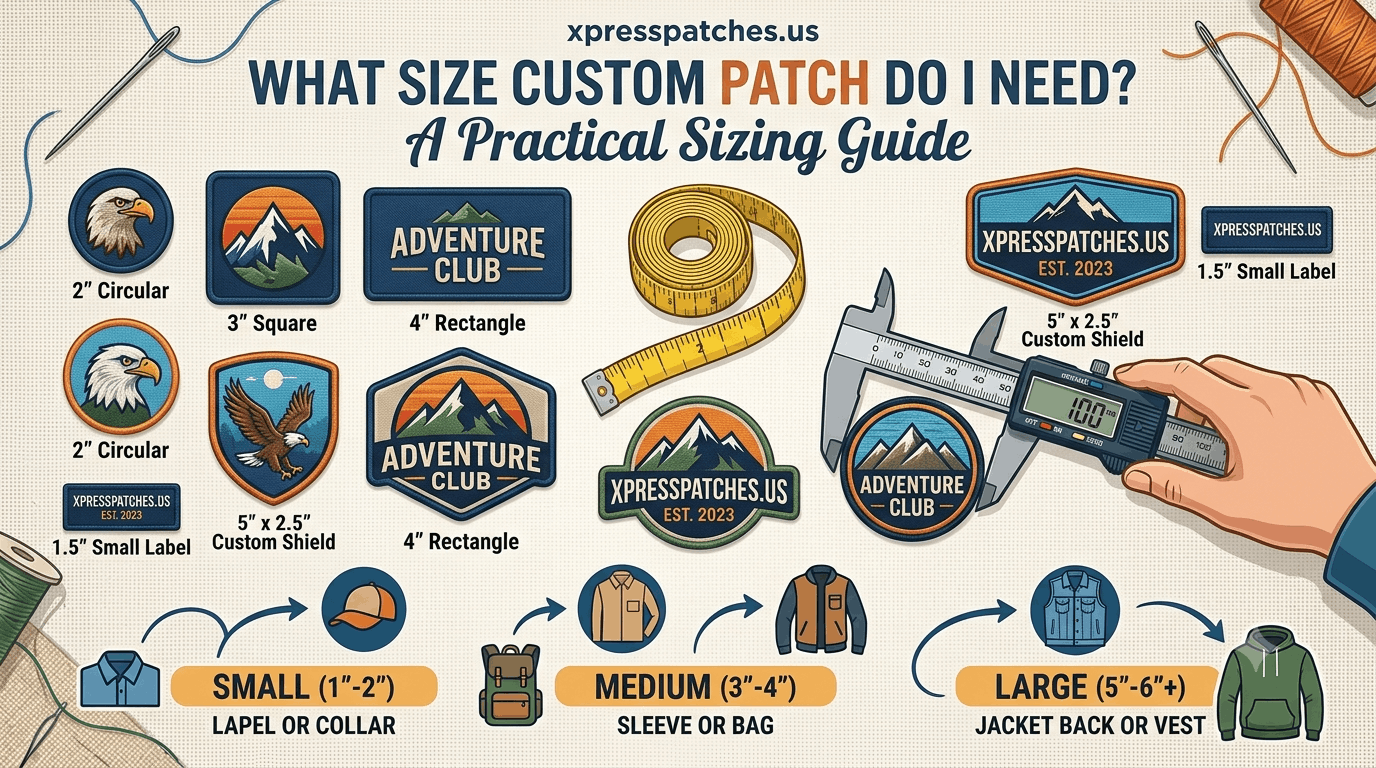
What size custom patch do I need? It sounds like a simple question, and it is — once you know the rules. The answer changes depending on where the patch is going: the front of a hat, the chest of a jacket, the full back panel, a sleeve, a bag. Get the size wrong and the best design in the world looks off. Too small and nobody can read it from three feet away. Too large and it overwhelms the garment. This guide gives you the numbers for every common placement, plus the logic behind them so you can adjust for your specific situation.
Start Here: Measure Before You Order
Before picking a size from a chart, measure the actual space where the patch will go. Use a ruler or fabric tape. Note the width and height of the usable area, then subtract at least half an inch on each side for breathing room. A patch that runs right to the edge of a pocket or seam looks crowded and often puckers the fabric. That measurement is your maximum. Your actual patch size should sit comfortably inside it.
A useful trick before ordering: cut a piece of paper to your intended patch size and hold it against the garment. It takes 30 seconds and catches size regrets before they happen.
What Size Custom Patch for a Hat?
Hats are one of the most common placements and one of the most misjudged. Patches look noticeably smaller on a cap than they do when you’re holding them in your hand, which is why first-time buyers consistently undersize and end up with a logo that disappears into the fabric.
- Front center panel (baseball cap): 2 to 3 inches wide. A 2.5 inch patch is the most-ordered size. If your logo is wider than it is tall, go closer to 3 inches.
- Side panel: 1.5 to 2 inches. Side patches stay small to fit within the narrower panel without crossing seams.
- Trucker hat front panel: 2.5 to 3.5 inches. The foam front is larger and holds a slightly bigger patch without looking out of proportion.
- Beanie (cuff): 1.5 to 2.5 inches. Keep it compact so it sits flat on the knit without puckering.
For a deeper look at hat patch options and application methods, see our complete guide to custom patches for hats.
What Size Custom Patch for a Jacket Chest?
The left chest is the single most common patch placement across workwear, uniforms, polo shirts, and corporate apparel. It’s where a logo or name goes on virtually every professional garment.
- Logo patch (chest): 3 to 4 inches wide. The 3 to 3.5 inch range is the sweet spot for most logos — visible enough to read clearly from a normal conversation distance, small enough to sit cleanly above a breast pocket.
- Name patches (uniform): 1 to 1.5 inches tall and 3 to 5 inches wide. This format fits above the breast pocket on most uniform shirts and stays consistent across team members.
- On a T-shirt: Stay at or under 3 inches on the chest. Lighter fabrics don’t need the visual weight of a larger patch.
- On a heavy jacket or fleece: You can push to 4 to 4.5 inches and it still sits proportionally.
What Size Custom Patch for a Jacket Back?
Back patches are where scale matters most. This is the largest canvas on any garment, and the patch needs to fill it with intention — not float in the middle of too much empty fabric or push too close to the seams.
- Standard jacket back patch: 8 to 12 inches wide, 8 to 10 inches tall. Measure your specific jacket back panel from seam to seam and leave at least 1 inch of margin on all sides.
- Biker and club back patches: typically 10 to 12 inches wide. A three-piece set with top rocker, center patch, and bottom rocker should be measured together so the rockers clear the center patch by roughly half an inch on each side.
- Varsity jacket back letter: 6 to 8 inches for the main letter. Chenille is the traditional material here — our guide to chenille patches covers the options in detail.
One thing to check before ordering a large back patch: whether your embroidery machine or patch supplier can run the full size in one pass. Many machines top out at around 8 by 12 inches per production run. Larger patches sometimes need to be split into sections and joined, which affects both cost and how the finished patch looks.
What Size Custom Patch for a Sleeve?
Sleeves curve and flex, which limits how large a patch can be before it starts to distort or restrict movement. Keep sleeve patches smaller than you might expect.
- Standard sleeve patch: 2.5 to 3.5 inches wide, 3 to 4 inches tall for adult garments.
- Flag patches (military/tactical): 2 by 3 inches is the most common format. Leave at least 0.75 inch clearance from the sleeve seam on all sides.
- Shoulder area patch: 3 to 4 inches, centered on the shoulder cap rather than the sleeve proper.
What Size Custom Patch for a Bag or Backpack?
Bags vary more than garments in terms of available panel space, so measuring is more important here than with standard clothing sizes. The general rules still apply though.
- Backpack main panel: 3 to 5 inches depending on panel width. Measure the flat area away from seams and zippers — both create uneven surfaces that make patches look warped.
- Morale patch panels on tactical bags: most loop panels on tactical bags accommodate a 2 by 3 inch patch comfortably. Some larger MOLLE-compatible bags have space for 3 by 4 or larger. Check the loop panel dimensions before ordering.
- Tote bags: 3 to 6 inches depending on the visual. Tote bags have more flat panel space than most garments and can carry a proportionally larger patch without looking cluttered.
What Size Custom Patch for Uniforms?
Uniform patches have more specific size conventions than casual apparel because they serve identification and compliance functions, not just aesthetic ones.
- Logo or crest patch (left chest): 3 to 3.5 inches is the industry standard for most service industry, hospitality, and corporate uniforms.
- Name patches: 1 to 1.5 inches tall, 3 to 5 inches wide depending on name length. The standard format leaves room for a full name in readable lettering.
- Department or role patches: 2 to 3 inches, placed on the shoulder or sleeve depending on the uniform system.
- Law enforcement and security: shoulder patches run 2.5 to 3.5 inches, often standardized within the organization. Always confirm sizing against the agency’s dress code before ordering.
The One Rule That Overrides the Charts
Charts are starting points. The real rule is this: if your design includes any text, the smallest letter in that text needs to be at least a quarter inch tall after the patch is made. Below that threshold, stitching blurs the letterform and the text becomes unreadable. If your design needs to be small and still carry readable text, consider a woven patch or a PVC patch — both hold finer detail at smaller sizes than embroidery can.
Frequently Asked Questions
What size custom patch do I need for a jacket chest?
For the left or right chest of a jacket, shirt, or polo, 3 to 4 inches wide is the standard. A 3.5 inch patch is the most frequently ordered size. Name patches on uniforms are typically 1 to 1.5 inches tall and 3 to 5 inches wide, depending on how much text they carry.
What size patch fits on the back of a jacket?
A jacket back patch typically runs 8 to 12 inches wide and 8 to 10 inches tall. Measure your specific jacket back panel from seam to seam and leave at least 1 inch of margin on all sides. Biker and club back patches usually sit at 10 to 12 inches wide.
What size custom patch fits on a hat?
For the front panel of a baseball cap, 2 to 3 inches wide is standard. A 2.5 inch patch is the most common size. Patches look smaller on a cap than in your hand, so sizing up slightly is often the right call for logos with any detail.
What is the minimum size for readable text on a custom patch?
For embroidered patches, letters need to be at least 0.25 inches tall to stay legible after stitching. If your design includes small text, it either needs a larger overall patch size or a switch to woven or PVC construction, which hold finer detail at smaller sizes. See our guide on why logos sometimes need adjusting for patches for more on this.
Not Sure What Size? Ask Before You Order
At Xpress Patches, the free digital mock-up we send with every quote shows your design at your chosen size on a placement reference. If the size is off, you’ll see it in the mock-up before production starts — not after. No minimum order, so you can start with one patch to test the size before committing to a full run.