Blog
Iron-On vs Sew-On vs Velcro Patches: Which Backing Should You Choose?

The choice between iron-on vs sew-on patches is one of the most common questions customers ask before placing their first order. Get it right and your patch stays sharp for years. Get it wrong and you may end up with a patch that peels off, damages the fabric, or simply cannot be attached at all. In this guide, we compare iron-on vs sew-on patches — and Velcro — across every key factor so you can make the right call for your specific garment and use case.
At Xpress Patches, all three backing types are available on every order at no extra charge. Therefore, the decision is purely about what works best for your project — not cost.
Iron-On vs Sew-On Patches: The Core Difference
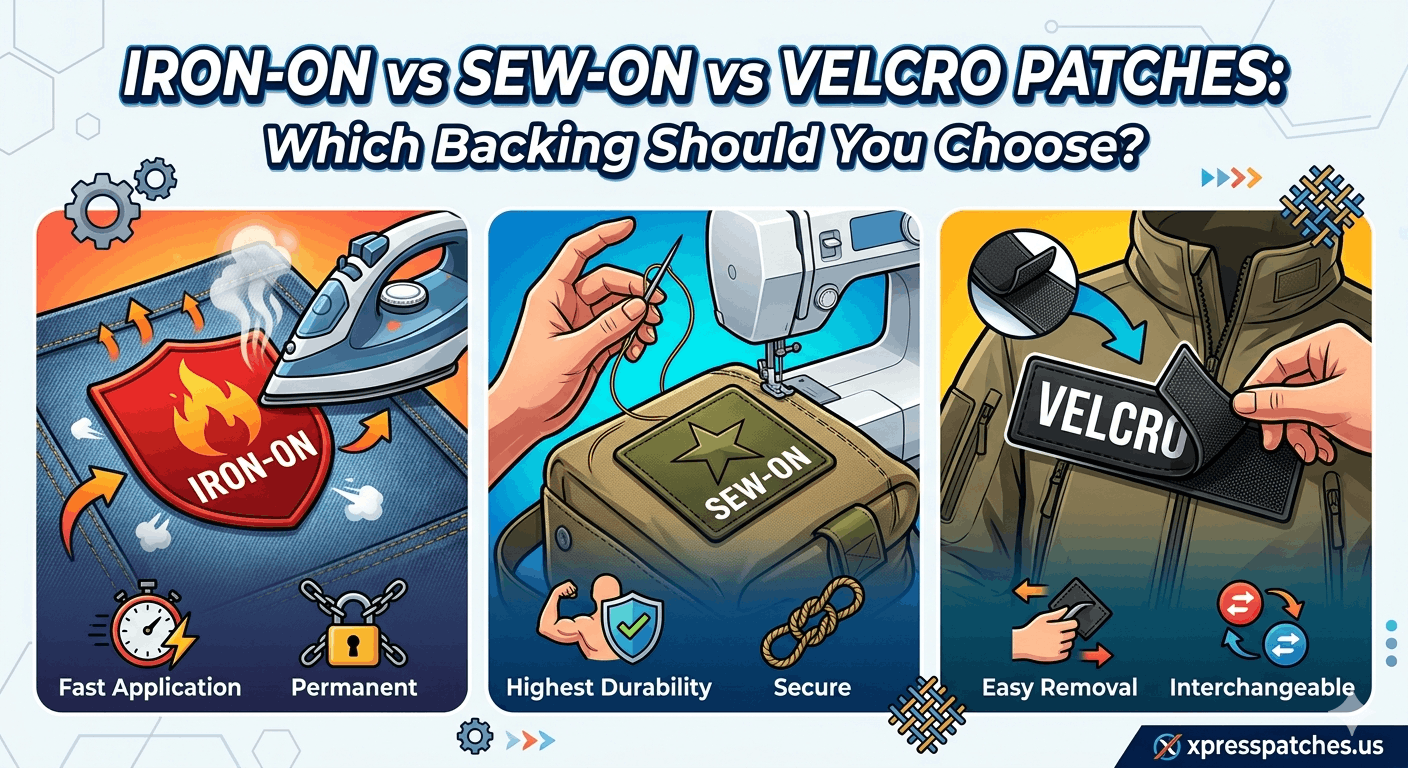
The fundamental difference between iron-on vs sew-on patches is how they attach to fabric. Iron-on patches use heat-activated adhesive that melts and fuses into fabric fibres when pressed with a hot iron. Sew-on patches use needle and thread to stitch through the patch border and into the garment — no heat required. Velcro patches use a hook-and-loop fastener that allows instant, damage-free swapping. Each method has clear advantages depending on fabric type, intended use, and how permanent you need the attachment to be.
Iron-On Patches: How They Work
How Iron-On Backing Works
Iron-on patches have a layer of heat-activated adhesive on the back. When you press a hot iron onto the patch for 25–30 seconds, the adhesive melts and fuses into the fabric fibres. As the patch cools, the adhesive re-hardens and creates a bond between patch and fabric. The key requirements are high heat (300–320°F / 150–160°C), firm pressure, and no steam. For a complete walkthrough, see our how to iron on a patch guide.
Best Fabrics for Iron-On Patches
- Cotton — the best choice. Handles high heat perfectly and bonds strongly.
- Denim — excellent. The tight weave holds the adhesive very well.
- Canvas and cotton-polyester blends — generally work well with care.
Fabrics to Avoid with Iron-On Patches
- Nylon and polyester — heat required to bond the adhesive melts these fabrics.
- Leather and faux leather — heat cracks and warps leather. Always sew on leather.
- Waterproof or treated fabrics — surface coating prevents adhesive penetration.
- Silk and delicate fabrics — too fragile for the heat required.
When to Choose Iron-On
Iron-on is the right choice when the garment is cotton or denim, you are applying the patch yourself without a sewing machine, and a permanent bond is preferred. It is the most convenient option for casual clothing, hats, bags, and personal items. Furthermore, combining iron-on adhesive with a few edge stitches after bonding gives a result almost as durable as pure sew-on.
Sew-On Patches: The Most Durable Option
How Sew-On Backing Works
Sew-on patches have no adhesive. They are attached by stitching through the patch border and into the garment fabric, by hand or machine. The patch has a plain fabric or felt backing that makes it easy to pass a needle through. Most embroidered patches and woven patches come with sew-on backing by default.
Why Sew-On Is the Most Durable Option
Sew-on patches last longer than any other attachment method. Thread anchored through both the patch and the garment fabric creates a mechanical bond that does not degrade with heat, moisture, or repeated washing. According to the Craftsy sewing guide, a properly sewn patch can last the full lifetime of the garment through 200+ washes with no loss of hold. Therefore, sew-on is the standard for professional uniforms, workwear, and any application where the patch must stay in place indefinitely.
Works on Any Fabric
Unlike iron-on vs sew-on patches in the fabric compatibility comparison, sew-on wins clearly — it works on any fabric including leather, nylon, waterproof jackets, silk, denim, canvas, and polyester. Needle and thread do not require heat, so there is no risk of fabric damage regardless of material. As a result, sew-on is always the safe choice when you are unsure about fabric type.
When to Choose Sew-On
Sew-on is the right choice for: uniforms washed frequently, leather garments and bags, nylon and synthetic outdoor gear, any application requiring maximum durability, and situations where you want the patch to look perfectly flat with no visible adhesive edge.
Velcro Patches: Instant Swap-ability
How Velcro (Hook-and-Loop) Backing Works
Velcro patches use a hook-and-loop fastening system. The patch has the hook side (rough side) on its back. A loop panel (soft side) is sewn permanently onto the garment. The patch attaches instantly when pressed onto the loop panel and peels off in seconds. Almost all morale patches use Velcro backing for exactly this reason.
When to Choose Velcro
Velcro backing is the right choice for morale patches and collections, military and law enforcement uniforms where role patches change between assignments, tactical vests, branded gear where patches need to be swapped between events, and any situation where the patch needs to be removed or repositioned regularly.
Iron-On vs Sew-On vs Velcro: Side-by-Side Comparison
| Factor | Iron-On | Sew-On | Velcro |
|---|---|---|---|
| Ease of application | Very easy | Requires sewing | Instant (needs loop panel) |
| Durability | Good on cotton/denim | Excellent — any fabric | Good — loop wears over time |
| Works on all fabrics | No — not nylon/leather | Yes | Yes (with loop panel) |
| Removable | Difficult | No — permanent | Yes — instantly swappable |
| Best for | Casual wear, DIY | Uniforms, workwear | Tactical gear, collections |
| Extra cost at Xpress Patches | None | None | None |
Can I Combine Iron-On and Sew-On?
Yes — and in many cases this gives the best result. The most popular combination is iron-on plus edge stitching. Iron the patch on first for quick positioning and initial hold, then add a running stitch or blanket stitch around the full border edge. This iron-on vs sew-on hybrid approach is especially recommended for uniforms, workwear, and patches washed more than once a week. As a result, you get the convenience of iron-on with the permanence of sew-on.
Quick Decision Guide: Iron-On vs Sew-On vs Velcro
- Cotton or denim, fast application, permanent bond? → Iron-on
- Nylon, leather, synthetic, or waterproof fabric? → Sew-on
- Uniform washed 3+ times per week? → Sew-on
- Need to swap patches between gear or events? → Velcro
- Tactical vest, plate carrier, or morale patch collection? → Velcro
- Maximum permanence on any fabric? → Sew-on
- Cotton garment, no sewing machine, casual use? → Iron-on (add edge stitches)
- Need patch to be removable without damage? → Velcro
Frequently Asked Questions — Iron-On vs Sew-On Patches
What is the difference between iron-on and sew-on patches?
Iron-on patches use heat-activated adhesive that bonds to fabric with a hot iron. Sew-on patches are attached by stitching through the patch border onto the garment — no heat or adhesive needed. Sew-on is more permanent and works on any fabric including leather and nylon. Iron-on is faster but only works reliably on cotton and denim.
Which patch backing lasts the longest?
Sew-on lasts the longest — potentially the full lifetime of the garment through hundreds of washes. Iron-on adhesive weakens over time especially with hot washing. Combining iron-on with edge stitching gives similar durability to pure sew-on and is the recommended approach for any patched item that will be washed frequently.
Can I iron on a patch to nylon or polyester?
No. The high heat required for iron-on adhesive — around 300–320°F — will melt or distort nylon and polyester fibres. Always use sew-on or Velcro backing on synthetic materials to avoid fabric damage.
Does Xpress Patches charge extra for Velcro or sew-on backing?
No. All three backing types — iron-on, sew-on, and Velcro — are available at no extra charge on any order at Xpress Patches. Simply specify your preferred backing when you submit your quote request.
Order Custom Patches with Your Preferred Backing
At Xpress Patches, all backing types are available on every patch style — embroidered, woven, PVC, chenille, and printed. No minimum order, free mock-up in 24 hours, 14-day delivery, and a 100% money-back guarantee.